LAILA ALI ADDS ANOTHER CHAPTER TO HER LEGACY
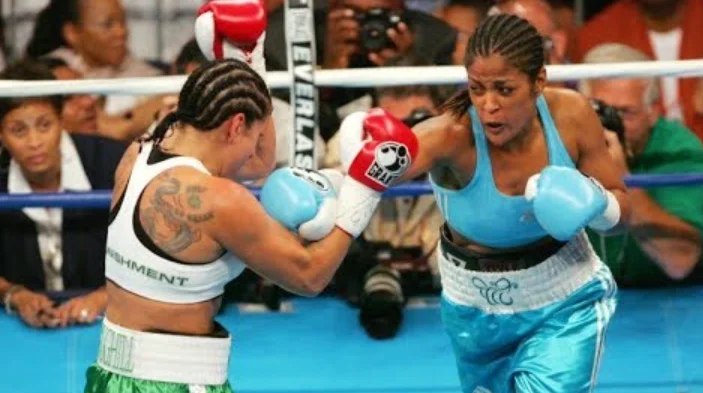
On June 11, 2005, at Washington’s MCI Center, Laila Ali defeated Erin Toughill by technical knockout at 1:54 of the third round, retaining her WIBA super middleweight title and capturing the inaugural WBC women’s super middleweight championship.
By the time the fight was announced, Laila Ali was already the most recognizable figure in women’s boxing. Being Muhammad Ali’s daughter opened doors, but it also invited scrutiny.
Ali turned professional in October 1999 and quickly emerged as one of the leading figures in a period when women’s boxing was still fighting for mainstream acceptance. Possessing genuine punching power and natural athleticism, she developed into a dominant force in the middleweight and super middleweight divisions. Before facing Toughill, she had already defeated several notable opponents, including Jacqui Frazier-Lyde, daughter of former heavyweight champion Joe Frazier, in one of the most publicized women’s boxing matches of its era.
Ali entered the Toughill fight with a perfect 20-0 record and 17 knockouts. Four months earlier she had stopped Cassandra Giger, continuing a championship run that had established her as the sport’s biggest attraction. While some critics questioned the depth of competition available in women’s boxing at the time, there was little debate about Ali’s status as the division’s leading figure.
Erin Toughill was one of the most versatile female combat athletes of her generation. Born in Chicago and raised in California, she built her reputation across multiple disciplines, including kickboxing, boxing, and mixed martial arts. Long before women’s MMA gained widespread recognition, Toughill was competing against high-level opposition and helping pave the way for future generations of female fighters.
Known as “Irish,” Toughill possessed a physical style that reflected her diverse combat sports experience. She entered the Ali bout with a professional boxing record of 6-1-1 and had shown enough talent and determination to secure a world title opportunity. Toughill was physically strong, battle-tested, and accustomed to competing under pressure.
Once the opening bell sounded, however, Ali quickly demonstrated her superiority. Using a sharp jab and superior timing, she established control from the outset. Toughill pressed forward and looked to impose herself physically, but Ali consistently beat her to the punch. The champion’s combinations were cleaner, her movement more effective, and her power increasingly apparent as the fight progressed.
The end came in the third round. Ali backed Toughill toward the ropes and unleashed a sustained barrage of punches. Referee Joseph Cooper stepped in at the 1:54 mark, waving off the contest and awarding Ali a technical knockout victory before a crowd of more than 15,000 spectators.
The win improved Ali’s record to 21-0 and added the newly created WBC women’s super middleweight championship to her growing collection of titles. More importantly, it reinforced her standing as the face of women’s boxing during a pivotal period in the sport’s development.
For Ali, the victory became another milestone in an impressive career. She retired in 2007 with a perfect professional record of 24-0, including 21 knockouts. Along the way she held championships recognized by the WBC, WIBA, IWBF, and IBA and became one of the most influential figures in the history of women’s boxing. Her achievements eventually earned her induction into both the International Women’s Boxing Hall of Fame and the International Boxing Hall of Fame.
For Toughill, the defeat did little to diminish her significance as a pioneering combat sports athlete. While she never captured a major boxing world championship, she continued competing in both boxing and mixed martial arts and remained a respected figure in the evolution of women’s MMA. Fighters like Toughill helped expand opportunities for women in combat sports years before the mainstream attention that would later transform the landscape.
Looking back more than two decades later, the fight serves as a snapshot of women’s boxing during a period of transition. The sport was still years away from the commercial breakthroughs that would eventually come through champions such as Katie Taylor, Claressa Shields, Amanda Serrano, and others. Opportunities were fewer, television exposure was limited, and many athletes were forced to build careers with far less support than modern champions enjoy.

We thank you for your support.
You can find us on facebook: ThePrizefighters.com
And on X: @TPF_ib_tv